
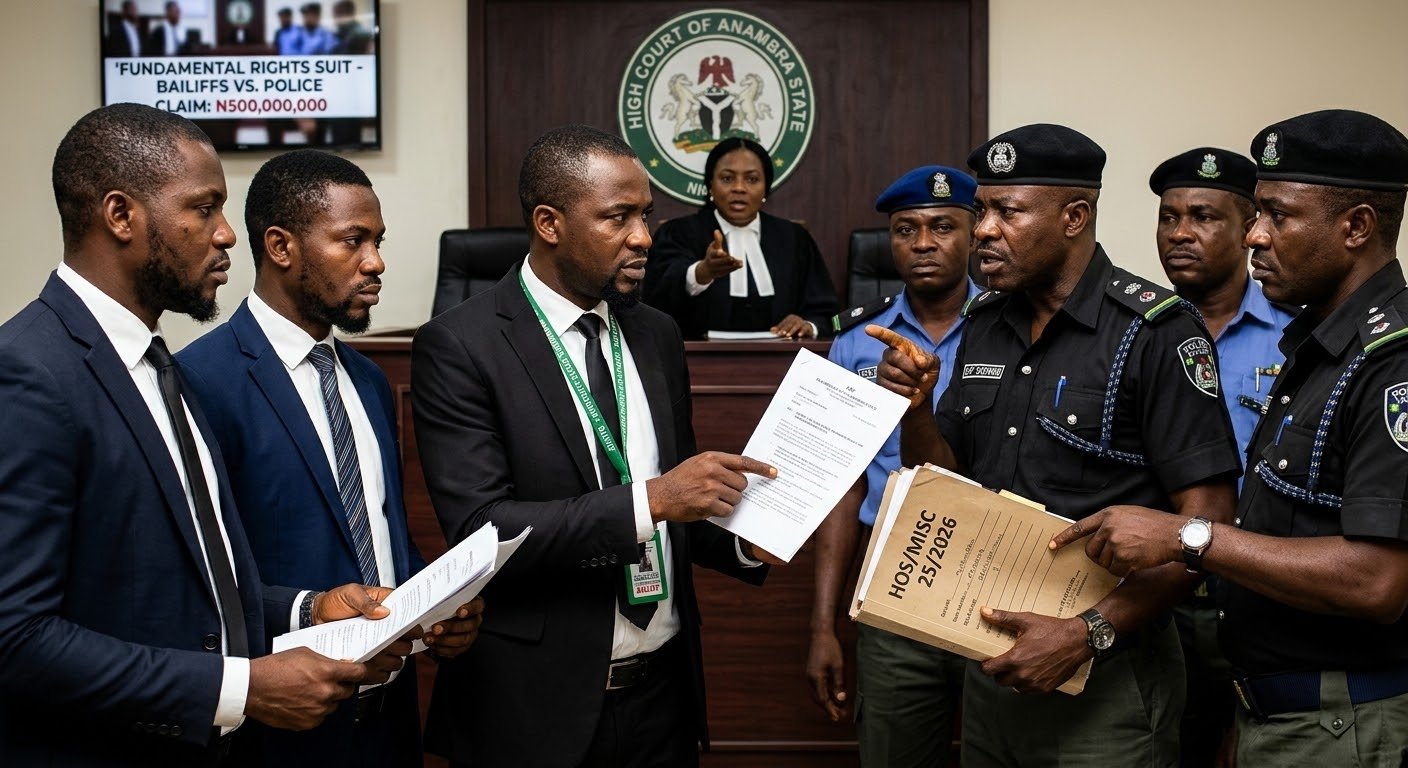
In a major legal escalation following a high-profile public altercation, five court bailiffs attached to the Chief Magistrate Court, Awka, have instituted a ₦500 million Fundamental Rights Enforcement suit against top police authorities and CSP Stephen Okwundu, the Divisional Police Officer (DPO) of ‘B’ Division Police Station, Awka.
The legal action, filed under Suit No: HOS/MISC 25/2026 at the High Court of Anambra State (Orumba South Judicial Division, Holden at Umunze), follows widespread public outcry and institutional condemnation by legal and judicial bodies over the treatment of court personnel while executing a judgment.
1. The Incident Behind the Suit
According to court filings and supporting affidavits, the conflict erupted on Wednesday, October 7, 2026, when five bailiffs—Nweje Francis, Onwuasoanya Franklyn Ifeanyi (Assistant Chief Bailiff), Okafor Ikenna Michael, Okeke Mmaduabuchi Leonard, and Umeh Chigozie Livinus—went to execute a valid court judgment (Suit No: MAW/15/2025) at a property behind the Central Bank of Nigeria (CBN) office in Okpuno, Awka.
The applicants allege that while performing their official duties, CSP Stephen Okwundu arrived at the scene in an official police Hilux vehicle and ordered them to halt execution. Despite the bailiffs producing official judiciary identity cards and a Warrant of Execution signed by a Magistrate, the DPO allegedly refused to recognize their authority and called for backup.
Upon arrival, backup operatives reportedly assaulted the court officials, tore their clothes, and attempted to forcibly seize the warrant. Video footage captured by a representative of the Judgment Creditor showing police officers physically harassing the bailiffs quickly went viral across social media platforms, sparking severe backlash against police high-handedness.
2. Backlash from JUSUN and the Nigerian Bar Association
The incident provoked immediate reactions from key stakeholders in the judicial sector:
- Judiciary Staff Union of Nigeria (JUSUN): JUSUN’s Anambra State Branch issued a stern statement condemning the DPO’s conduct as “reckless and unprofessional,” describing it as a direct assault on the independence and authority of the judiciary.
- Nigerian Bar Association (NBA): Legal bodies, including local NBA branches, condemned the police interference, emphasizing that law enforcement officers must operate within constitutional boundaries and respect judicial enforcement processes.
- Anambra Police Command Response: In response to the viral video, the Anambra State Police Command urged public restraint, stating that it had launched an internal investigation to determine the full circumstances surrounding the rift.
3. Reliefs Sought by the Bailiffs
Unsatisfied with mere administrative probes, the aggrieved judicial workers have now taken the matter to the High Court, seeking constitutional remedies:
- Declarations of Rights Violation: A court declaration that the physical assault, beating, and humiliation infringed upon their fundamental rights to life and dignity of the human person under Sections 33(1) and 34(1)(a) of the 1999 Constitution (as amended).
- Perpetual Injunction: An order restraining the Police Service Commission, the Inspector General of Police (IGP), the Anambra State Commissioner of Police, and CSP Stephen Okwundu from further harassing or intimidating them.
- Public Apology: An explicit court order directing DPO Stephen Okwundu to issue an unreserved written apology published in Vanguard Newspaper and two other national dailies circulating within Anambra State.
- ₦500 Million Damages: Joint and several monetary compensation of ₦500,000,000 for trauma, physical harm, and gross violation of their constitutional rights.
4. What Lies Ahead
The suit brings into sharp focus the recurring institutional friction between law enforcement agencies and judicial officers carrying out court orders. With legal proceedings now active, all eyes are on the Anambra State High Court as it prepares to hear the motion on notice and determine the extent of police liability.
